SFT 2026-27 - LLASO Project 5 - Semi-Autonomous - Lunar Robots Repair Garage (Shirt-Sleeve Maintenance Facility)
SFT 2026-27 LLASO Project 5 - Semi-Autonomous - Lunar Robots Repair Garage (Shirt-Sleeve Maintenance Facility)
NASA Reference Name: LLASO-P5-GARAGE-2026
Executive Summary
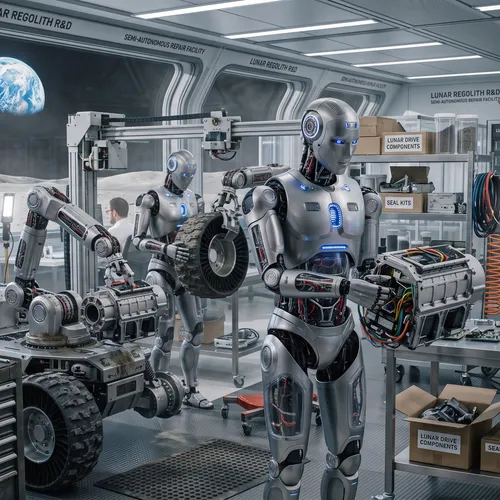
Design a pressurized 'shirt-sleeve' garage where humans and maintenance robots can service the lunar robot fleet without EVA suits. It accepts robots through a dust-exclusion airlock, provides service bays and parts storage, and receives work orders from the Project 4 AI system. It is the physical home that ties Projects 2, 3, and 4 together. Deliverable: a facility floor plan, an ingress/egress dust-control design, an operations workflow, and a physical or CAD mock-up of at least one service bay, plus robots that can actually do as many repairs as possible, starting with Parts or Subsystem SWAPS, if possible board SWAPS in a SUBSYSTEM, and the Board and Component Testing and Repair.
Requested By
NASA HUNCH / Kennedy Space Center; NASA Habitation / Robotics.
Problem Statement
The growing lunar robot fleet (transport, unloading, mining, construction) will require regular maintenance and repair. Doing this work in full EVA suits is slow, expensive, and risky. A pressurized shirt-sleeve facility is needed where both humans and maintenance robots can work efficiently. Note: some robots will remain inside buildings only, and others will be outside-only robots.
Requirements Overview
A non pressurized and a pressurized shirt-sleeve interior (no EVA suit required for normal work)
A dust-exclusion airlock or wash-down zone for robots entering from regolith
A minimum of 2 service bays plus 1 standby parking area
Tool and parts storage integrated into the bay layout
A work-order interface that receives dispatch from the P4 AI system
A robot return-to-service certification process before redeployment
Redundant power and air supply (no single point of failure)
Major Constraints
Regolith is abrasive and electrically charged — it must be fully excluded before the pressurized area
Potential for a Robot only Bay
A shirt-sleeve environment means all repair work happens without pressure suits — this is safety-critical
The facility must function during uncrewed mission phases (maintenance robots work autonomously)
Size and mass constraints: the garage must be modular and deliverable by existing or near-term launch vehicles
Key Challenges
Designing a Simple airlock that can pass a large wheeled robot without letting regolith through
Determining the right balance of human vs. robotic technician tasks in the bay or different bays
Keeping the facility operational when humans are not present for months
Sourcing, storing, and tracking spare parts in a supply-constrained environment
Missions
Here is a **14-mission progression designed for high-school prototype demonstrations**, with Missions 1–8 establishing core garage capabilities and Missions 9–14 pushing toward increasingly autonomous and innovative operations.
## Basic Operations — Missions 1–8
**Mission 1 — Welcome to the Lunar Garage**
A simulated lunar robot arrives at the garage and requests entry for scheduled maintenance. The student system must identify the robot, read its ID or QR/RFID tag, verify that it has a valid work order, and direct it to the correct entry location.
**Mission 2 — Leave the Moon Dust Outside**
The robot enters a simulated dust-exclusion airlock carrying substitute lunar regolith such as fine sand, and the prototype must perform a cleaning or wash-down sequence before allowing it into the pressurized garage. Students must demonstrate that their system minimizes the amount of simulated regolith transferred into the clean maintenance area, directly addressing one of the project's major constraints. ([nasahunch.com][1])
**Mission 3 — Find Your Service Bay**
After passing the dust-control system, the robot must autonomously or semi-autonomously navigate to an assigned service bay without colliding with equipment, walls, stored parts, people, or another robot. The garage system must track whether each of its minimum two service bays and standby parking area is **AVAILABLE, OCCUPIED, RESERVED, or OUT OF SERVICE**. ([nasahunch.com][1])
**Mission 4 — Diagnose Before You Repair**
At the service bay, the maintenance system receives telemetry and a work order identifying a suspected problem such as a failed wheel motor, sensor, battery module, control board, or communications subsystem. Students must demonstrate a diagnostic procedure that confirms or rejects the suspected fault before parts are removed.
**Mission 5 — Parts and Subsystem Swap**
The maintenance robot or student-designed service mechanism must remove a simulated failed modular component and install a replacement—for example, a wheel assembly, battery module, sensor package, motor, or electronics box. The system must verify that the correct replacement part was installed and update the work order and spare-parts inventory, reflecting HUNCH's emphasis on beginning with parts and subsystem swaps. ([nasahunch.com][1])
**Mission 6 — Circuit Board Swap**
A diagnostic test identifies a simulated failed electronics board inside a subsystem, requiring the repair system to open the appropriate access area, identify the correct board, remove it, and install a replacement. The prototype must then perform a power-up or simulated functional test demonstrating that the replacement board communicates correctly with the robot.
**Mission 7 — Two Robots, Two Repairs**
Two robots arrive with different maintenance needs, forcing the garage to manage both service bays simultaneously while maintaining safe separation between robots, humans, tools, and parts. Students must demonstrate work-order tracking, bay scheduling, parts allocation, and maintenance status for both repairs while keeping the standby parking/charging area available. ([nasahunch.com][1])
**Mission 8 — Certified: Return to the Moon**
Completing a repair is not enough—the repaired robot must pass a return-to-service inspection including simulated mobility, communications, sensors, power, and subsystem tests. Only after all required tests pass may the garage digitally certify the robot **READY FOR SERVICE**, open the exit sequence, and return it to the lunar fleet, demonstrating the full HUNCH workflow from AI dispatch through repair, testing, and redeployment. ([nasahunch.com][1])
## Innovative / Out-of-the-Box Missions — Missions 9–14
**Mission 9 — The Robot Checks Itself In**
An arriving robot autonomously enters a diagnostic station, uploads its telemetry and maintenance history, identifies its probable fault, and pre-stages its own repair work order before entering a service bay. The garage then compares the robot's diagnosis with Project 4's AI-generated diagnosis and determines what tests and parts should be prepared—a concept specifically suggested by HUNCH as an innovation. ([nasahunch.com][1])
**Mission 10 — Robotic Pit Crew**
Challenge students to create the lunar equivalent of a Formula 1 pit crew: multiple robotic mechanisms simultaneously inspect, test, remove, replace, and verify components to minimize the robot's time out of service. The system must determine which repair tasks can safely occur in parallel and automatically coordinate tools and mechanisms without collisions or interference.
**Mission 11 — Humans + Robots Repair Together**
An astronaut and maintenance robot must collaboratively complete a complicated repair, with the system deciding which tasks are best performed by the human and which should be performed robotically. Students could incorporate voice commands, computer vision, gesture recognition, AR instructions, projected work zones, smart tools, or AI-generated procedures while demonstrating that the robot recognizes and safely responds to the human technician. ([nasahunch.com][1])
**Mission 12 — No Astronauts on the Moon**
Simulate an uncrewed period in which a robot develops a fault while no astronauts are available to perform maintenance. The garage must autonomously receive the Project 4 work order, admit and clean the robot, diagnose it, select a replacement component, execute or simulate the repair, test the robot, and return it to service—with human intervention permitted only if the autonomous system declares that it cannot safely complete the repair, addressing HUNCH's requirement for autonomous operation during uncrewed phases. ([nasahunch.com][1])
**Mission 13 — Nothing Gets Thrown Away on the Moon**
Instead of automatically discarding a failed component, the system must inspect it and decide whether it should be **REPAIRED, REUSED, REPURPOSED, RECYCLED, or STORED FOR RETURN**. Advanced teams could demonstrate a robotic system that salvages usable motors, gears, electronics, fasteners, wiring, structural materials, or other components and automatically adds them to a digital lunar inventory—extending HUNCH's suggested innovation of routing repair waste into a future LLASO recycling/reuse system. ([nasahunch.com][1])
**Mission 14 — Lunar Garage Emergency: Keep the Base Running**
For the ultimate challenge, several robots arrive with different failures while one service bay is unavailable, a needed replacement part is in short supply, an unexpected dust-control problem occurs, and Project 4 reports that another mission-critical robot may soon fail. Without direct human control, the garage must prioritize repairs, manage its two bays and standby robots, diagnose faults, allocate scarce parts, execute or simulate repairs, handle recoverable components, certify repaired robots, and continuously communicate status with the lunar fleet—then produce a final **Garage Mission Report** explaining every major decision it made.
### Why this progression works
The 14 missions create a logical student-development path from **Garage Entry → Dust Removal → Navigation → Diagnostics → Subsystem Swap → Board-Level Repair → Multi-Robot Operations → Certification**, followed by **Self-Diagnostics → Robotic Pit Crew → Human/Robot Collaboration → Fully Autonomous Repair → Lunar Recycling → Autonomous Garage Management**.
It also allows teams with different capabilities to succeed. NASA HUNCH explicitly permits high-school teams to use a **scale garage model**, simulate regolith with substitute material, represent the operations workflow as a process diagram, or concentrate on one major subsystem rather than constructing an entire full-scale facility. ([nasahunch.com][1])
Please NOTE: All Robot Projects require a Tracking and Logging of the status of their robots I recommend you implement this input file, plus a ticketing system from Project 4. https://nasahunch.com/projects/sft-2026-27-additional-resource-hub-for-software-and-hardware-engineering-plus-robotics-hqao7leix1a9ux5ql75nif0g
[1]: https://nasahunch.com/projects/sft-2026-27-llaso-project-5-semi-autonomous-lunar-robots-repair-garage-shirt-sleeve-maintenance-facility--ss8ihkqz8l4mjqd9sy41v4n1 "SFT 2026-27 - LLASO Project 5 - Semi-Autonomous - Lunar Robots Repair Garage (Shirt-Sleeve Maintenance Facility)"
Please Click the link here for more robot information
More Info below
Other Suggestions for High School Students
Cards
1 — Other Points / Comments
This project ties together P2, P3, and P4 — the garage is the physical home for the AI dispatch system
Encourage teams to study ISS maintenance operations and terrestrial cleanroom designs for inspiration
The human/robot collaboration model inside the garage is a rich design space: who does what, and when?
Connect to Space Force engagement: military forward-operating-base maintenance facilities are a useful analog
2 — Examples of Excellence
A full dust-exclusion airlock is designed with a robot wash-down cycle and tested with a substitute granular material
The operations workflow covers the full loop: AI dispatch received, bay assigned, repair completed, robot tested, robot returned to fleet
The facility includes a standby robot parking and charging zone that feeds directly into the P4 standby rotation
3 — Examples of Innovation
A modular bay design: additional bays snap on as the robot fleet grows, scalable to a lunar campus
The robot self-checks in at a diagnostic station on entry and pre-stages its own repair work order
Waste material from repairs is sorted and routed to the LLASO recycling / reuse track (a future project)
Suggestions for High School Students
A scale model of the garage is acceptable instead of a full-size prototype
The dust-exclusion system may be simulated with a substitute material (for example, fine sand)
The operations workflow may be presented as a process diagram rather than a live system
Teams may focus on just one aspect: layout design OR dust exclusion OR the work-order system