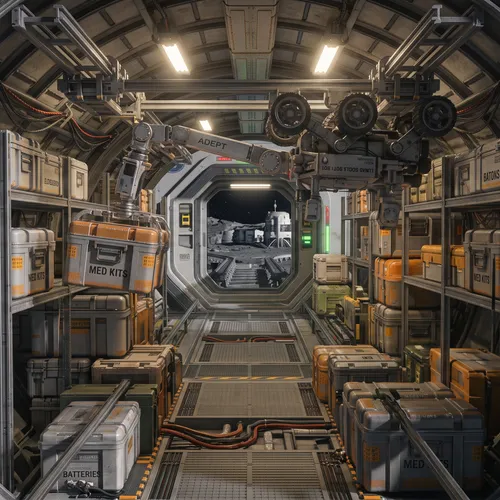
SFT 2026-27 - LLASO Project 3 - Internal Cargo Unloading Robot (Inside the Module)
LLASO Project 3 - Internal Cargo Unloading Robot (Inside the Module)
NASA Reference Name: LLASO-P3-UNLOAD-2026
Executive Summary
Design and prototype a robot that works inside a pressurized, cylindrical cargo module to retrieve, classify, and hand off cargo items — adapting to a curved interior and low-gravity handling while working safely alongside human crew. Deliverable: a working prototype or simulation demonstrating navigation of a cylindrical interior and item handoff in 1/6 g.
Requested By
NASA HUNCH / Kennedy Space Center; NASA Habitation / Marshall
Problem Statement
Once a cargo module is docked to the habitat, someone or something must go inside and systematically remove the cargo items, in a pressurized shirt-sleeve environment. (Assume that once the module is docked, regolith is considered controlled.)
Requirements Overview
Operate inside a cylindrical module (~3 m dia.) in a pressurized environment
Handle CTBs, equipment racks, and bulk cargo items
Adapt to 1/6 g mass handling (items are lighter, but inertia is the same)
Communicate item identity and status to a manifest system
Work alongside human crew without creating a safety hazard
Major Constraints
The interior is cylindrical — no flat floor unless a floor insert is fitted, so the robot must adapt
Tight quarters: the robot must not block the central aisle while retrieving items
Regolith may coat the exterior surfaces of the cargo container — the robot must not transfer it inward
Items may be in 2- or 3-stack configurations, so the robot must handle vertical reach
Key Challenges
Reaching top-stack cargo without tipping or dropping items
Maintaining a precise grip on items of varying size and mass in low gravity
Navigating a curved interior floor without dedicated floor tracks
Coordinating with human crew to avoid workspace conflicts
Missions
## Basic Operations — Missions 1–6
**Mission 1 — Wake Up, Navigate & Return**
The robot begins at a designated home position, autonomously travels from one end of the cylindrical cargo module to the other, stops at designated checkpoints, and returns home. The prototype must demonstrate stable movement on the curved or simulated curved interior without contacting walls, cargo, or other obstacles.
**Mission 2 — Find the Cargo**
Place three Cargo Transfer Bag (CTB) mockups at different locations inside the module, and have the robot locate and correctly identify each using a barcode, QR code, RFID tag, computer vision, or another identification method. The robot must report each item's identity and location to a simple digital cargo manifest.
**Mission 3 — Pick It Up Without Dropping It**
The robot must retrieve three cargo items having different sizes, shapes, and simulated masses and move each to a designated unloading location. Students must demonstrate controlled gripping and movement that accounts for the important lunar problem that an object's weight is reduced in 1/6 g while its mass and inertia remain unchanged. ([nasahunch.com][1])
**Mission 4 — Reach the High Stack**
Cargo is placed in two- and three-level stacks, requiring the robot to retrieve an item from the lowest, middle, and highest positions. The robot must demonstrate sufficient vertical reach and stability to remove the cargo without tipping, dropping the item, or disturbing neighboring cargo.
**Mission 5 — Unload in the Correct Order**
Provide the robot with a manifest containing at least five cargo items and a required unloading priority—for example, medical supplies first, food second, maintenance equipment third. The robot must identify, retrieve, transport, and hand off the five items in the correct sequence while automatically updating their status in the manifest.
**Mission 6 — Astronaut in the Aisle**
Introduce a simulated astronaut into the robot's workspace while it is unloading cargo. The robot must detect the astronaut, slow or stop when necessary, preserve a safe central aisle, and then safely resume its mission without requiring a complete restart—addressing HUNCH's requirement that the system work alongside human crew without creating a safety hazard. ([nasahunch.com][1])
## Innovative / Out-of-the-Box Missions — Missions 7–12
**Mission 7 — The Mystery Cargo Challenge**
Add several cargo containers the robot has never encountered before, including different dimensions, orientations, labels, and simulated masses. Using sensors, computer vision, AI, or adaptive gripping, the robot must determine how to safely pick up each unknown object and select an appropriate unloading strategy without being explicitly programmed for that particular item.
**Mission 8 — Something Is Wrong**
Hide a damaged, leaking, incorrectly labeled, or improperly packed mock cargo item among normal supplies. The robot must autonomously recognize the anomaly, refuse normal delivery, alert the manifest system, and safely route or designate the suspicious item for a quarantine area—an innovation specifically contemplated by the HUNCH project description. ([nasahunch.com][1])
**Mission 9 — Lunar Module Tetris**
As cargo is removed, the robot must recognize newly available space and autonomously reorganize the remaining containers to improve astronaut access, maintain the central aisle, and make high-priority cargo easier to retrieve. Extra credit could be awarded if the robot converts the interior from a tightly packed transportation configuration into an organized "open shelf" configuration, another innovation identified in the project brief. ([nasahunch.com][1])
**Mission 10 — The Emergency Supply Hunt**
During normal autonomous unloading, Mission Control suddenly requests an emergency item—for example, an oxygen-system repair kit or medical supply—that may be buried behind other cargo. The robot must interrupt its current task, determine the fastest safe retrieval sequence, temporarily relocate blocking containers, retrieve and deliver the emergency item, update the manifest, and then intelligently resume its original mission.
**Mission 11 — Robot + Astronaut Team Challenge**
Instead of treating astronauts only as obstacles, the robot must recognize when a human enters the workspace and determine how the two can safely work together—for example, robot unloads high or heavy cargo while the astronaut handles smaller items. Students could add voice commands, gesture recognition, AR indicators, projected safe zones, or another human-robot interface that allows the astronaut to redirect the robot without using a conventional controller.
**Mission 12 — The Autonomous Lunar Unloading Supervisor**
For the final challenge, give the robot a completely loaded module, a manifest containing at least 10 mixed cargo items, unexpected obstacles, one damaged or incorrectly packed item, changing cargo priorities, and an astronaut periodically entering its workspace. Without direct human control, the system must plan and execute the unloading operation, identify and classify cargo, optimize retrieval order, safely hand off supplies, respond to anomalies, continuously update the manifest, and produce a final telemetry/log report explaining **what it did, what problems it encountered, and how it responded**.
This final mission would combine most of the project's stated "Examples of Excellence": navigating the module, retrieving multiple cargo types, updating the manifest in real time, and completing an unloading sequence autonomously. ([nasahunch.com][1])
A useful next step would be to turn these into a **NASA HUNCH Mission Challenge Matrix** with each mission scored on **Navigation, Cargo Handling, Autonomy, Safety, Software/AI, Manifest Integration, Innovation, and Mission Success**, including measurable pass/fail criteria for student prototype demonstrations.
[1]: https://nasahunch.com/projects/sft-2026-27-llaso-project-3-internal-cargo-unloading-robot-inside-the-module--32?utm_source=chatgpt.com "SFT 2026-27 - LLASO Project 3 - Internal Cargo Unloading Robot (Inside the Module)"
Please Click the link here for more robot information
More Info below
Other Suggestions for High School Students
The robot may be humanoid, wheeled, or a rail-guided arm system
An Earth-scale demo is acceptable; 1/6 g may be modeled in simulation only
Handoff can be to a stationary supply shelf rather than a moving rover
The manifest system can be a simple checklist rather than a full database
A rail-guided arm is the easiest entry point if you are new to robotics