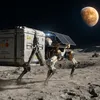
SFT 2026-27 LLASO Project 2 - External Cargo Transport Robot (Rocket to Supply Building)
LLASO Project 2 - External Cargo Transport (Earth-Load and Optimize to Habitat-Unload and Retrieve)
NASA Reference Name: LLASO-P2-XPORT-2026
Executive Summary
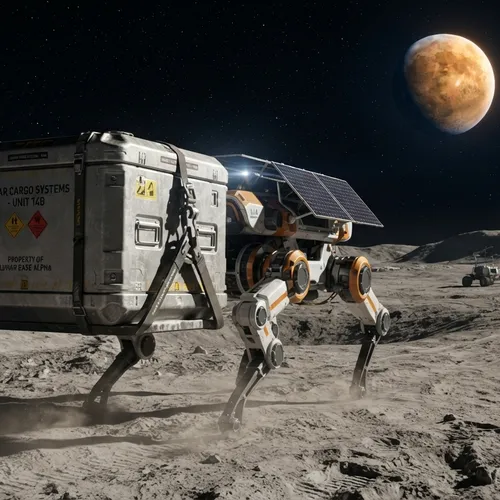
Design and prototype a robot that moves a landed cargo module from the landing pad to the habitat's supply building and docks it to a pressurized port — in low gravity, over unprepared regolith, and without requiring an astronaut to go outside. Deliverable: a concept prototype robot, or a high-fidelity CAD / simulation, with a demonstrated navigation and docking sequence.
Requested By
NASA HUNCH / Kennedy Space Center; NASA Robotics / Marshall Habitation
Problem Statement
Once a ~40 ft cargo module lands on the lunar surface, it must be moved from the landing pad (kept away from the habitat to avoid plume contamination) to the supply building and docked to a pressurized port — without human EVA involvement wherever possible. Possible 20 ft cargo container plus 4 ft pods. Containers can Be Rectangular prisms or Cylinders.
Requirements Overview
Handle a module mass equivalent in 1/6 g (may be scaled for an Earth demo)
Navigate unprepared lunar regolith terrain
Include a dust-exclusion coupling at the habitat dock (~1-2 m opening)
Operate autonomously, with human override capability
Use a solar + battery power architecture
Require no human EVA for nominal transport operation
Major Constraints
Regolith is abrasive and clings electrostatically — all seals and joints must account for it
The plume blast zone means the module lands far from the habitat, so the robot must traverse a significant distance
1/6 g means lighter loads but also lower traction for wheeled/tracked systems
The docking interface must seal to the habitat pressure boundary before the module hatch opens
Key Challenges
Designing a gripper or cradle that handles an irregular cylindrical load
Push you robot to butt again a straight surface ( Simulated Air Lock )
Budgeting power for a long-distance traverse with a heavy load
Avoiding tipping instability when carrying an elevated load in low gravity
Missions do as many as you can
12 Missions: Earth Loading, Lunar Surface habitat Unloading and Retrieval
**Mission 1 — First Drive: Leave the Landing Zone**
Demonstrate that the robot can safely start, stop, turn, reverse, and travel from a simulated lunar lander across an uneven lunar surface. The robot must reach a designated staging area without striking the lander, cargo, or obstacles.
**Mission 2 — Find and Approach the Cargo**
The robot must locate a cargo pod at the landing site and position itself correctly for pickup. Students demonstrate controlled alignment, approach, and docking without manually repositioning either the robot or cargo.
**Mission 3 — Pick Up and Secure One Cargo Pod**
Retrieve one simulated **4-ft × 2-ft Astrobotic cargo pod** and mechanically secure it for transportation. The robot must demonstrate that the load remains stable while starting, stopping, turning, and traversing uneven terrain.
**Mission 4 — Transport Cargo to the Habitat**
Carry the pod from the simulated landing zone to the supply-building/habitat area without dropping or damaging it. The course should include rocks, slopes, turns, loose-regolith simulation, and other obstacles representative of lunar surface transportation.
**Mission 5 — Deliver and Place the Cargo**
At the habitat, the robot must accurately position and unload the cargo into a designated receiving zone. Success requires both transportation and controlled cargo placement—not simply dropping the payload near the building.
**Mission 6 — Complete a Full Logistics Cycle**
Demonstrate an end-to-end mission: receive a cargo assignment, navigate to the lander, acquire the payload, transport it, deliver it to the correct destination, and return for another load. Students should measure mission time, distance traveled, energy consumed, positioning accuracy, and successful delivery.
---
# Advanced / Innovative Missions
**Mission 7 — Navigate the 2-km Lunar Supply Route Autonomously**
Simulate the storyboard's **2-km separation between the landing pad and habitat**, scaled appropriately for the prototype course. The robot must autonomously follow or determine a safe route while avoiding craters, rocks, restricted zones, steep terrain, and simulated landing-plume hazard areas.
**Mission 8 — One Robot, Three Very Different Cargo Systems**
Develop an adaptable cargo-handling concept capable of working with the three logistics architectures represented in the lunar-base scenario: **Astrobotic's smaller pods, a Blue Origin cylindrical cargo module, and a SpaceX-scale shipping-container concept**. Students do not necessarily need to lift full-scale representations; instead, their prototype should demonstrate a scalable interface, attachment system, or modular cargo-handling architecture.
**Mission 9 — Two Robots Cooperate Without Humans**
Two robots must work together to accomplish a task that one robot cannot efficiently complete alone—for example, moving an oversized habitat component, positioning cargo, clearing a route, or transferring a payload between vehicles. The robots should communicate their position, task status, cargo condition, and next action while preventing collisions.
**Mission 10 — Something Goes Wrong**
During the mission, judges introduce an unknown problem: a blocked road, failed sensor, communications loss, low battery, shifted cargo, disabled wheel, or unavailable receiving location. The robot must detect the problem and either autonomously select a safe alternative or communicate enough diagnostic information for a remote operator to make a decision.
**Mission 11 — AI Lunar Logistics Manager**
Instead of telling the robot exactly what to do, give the system several cargo requests with different priorities—for example: habitat supplies, replacement batteries, life-support equipment, scientific instruments, and emergency repair parts. The students' software must determine **what should move first, which robot should move it, which route to use, and when the mission should occur**, then demonstrate the resulting plan with the prototype.
**Mission 12 — Build Something That Wasn't Requested**
Give teams an open-ended challenge: **"What capability will a lunar cargo robot need that NASA hasn't asked you to demonstrate yet?"** Teams identify the problem and demonstrate their own innovation—for example, self-charging, robotic trailer trains, automatic cargo identification, cooperative lifting, regolith-clearing attachments, predictive maintenance, autonomous emergency resupply, swappable tools, temporary road construction, or using cargo containers as structural components of the lunar base.
### Why this progression works
The first six missions establish measurable engineering fundamentals: **mobility → navigation → acquisition → transport → delivery → complete logistics operation**. The second six deliberately move students toward **autonomy → adaptability → multi-robot cooperation → fault tolerance → AI decision-making → original invention**, which fits NASA HUNCH's stated emphasis on authentic, open-ended engineering challenges and working prototypes. ([nasahunch.com][2])
For the final demonstration, I would make **Mission 6 the minimum "fully operational prototype" benchmark** and Missions 7–12 opportunities for teams to demonstrate increasingly sophisticated capabilities rather than requiring every team to solve every advanced mission. That gives beginning teams an achievable target while giving advanced robotics, AI, engineering, and computer-science teams considerable room to distinguish their solutions.
[1]: https://nasahunch.com/projects/sft-2026-27-llaso-project-2-external-cargo-transport-robot-rocket-to-supply-building--o2mwe895htv0toqte8c09fasrobot "NASA HUNCH"