SFT 2026-27 - AI Plant Growth for Space
NASA Reference Name: ERT-P1-2026-AI-Plant - Lunar - Autonomous - Robot
Executive Summary
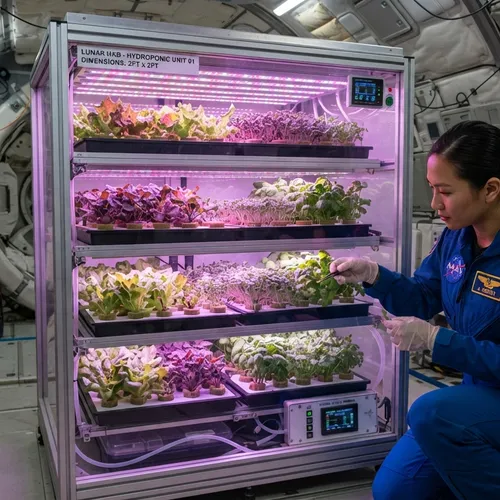
Build an AI-assisted system that monitors enclosed-habitat plants in real time, automatically adjusts conditions to reduce stress, and actively promotes the growth of each individual plant — factoring in artificial light and reduced (1/6 g) gravity. Deliverable: an automated 'robot greenhouse' concept/prototype that diagnoses issues and adjusts care (water, light height, climate) per plant, a defined list of monitored stressors, and a proposed pollination-automation approach.
Requested By
NASA — NASA Staff, Exploration Research and Technology, Kennedy Space Center
Problem Statement
Astronauts must grow plants inside confined Moon, Mars, and ISS habitats where resources — especially water — are scarce and crew time is extremely limited. Individually potted plants face multiple stresses (water, air, temperature, airflow, soil pH, radiation), and tasks such as watering and pollination are done by hand. A system is needed that uses AI to detect plant stress in real time, automatically reduce it, and promote healthy growth per plant while conserving resources.
Requirements Overview
Real-time, 24/7 monitoring with automated feedback control
AI stress detection: water, air, temperature, airflow, soil pH (and radiation)
Individualized watering — no over- or under-watering
Automated growth promotion (e.g., adjustable LED light height)
Resource-efficient: minimal water use and crew time
Automated pollination method (e.g., air-blast)
Contamination control / growth-medium sterilization
Major Constraints
Water is the most precious, limited resource — essentially zero waste allowed
Astronaut time is extremely limited — no hours for manual care or pollination
Confined, enclosed habitat — individual potted plants, not large crops
Reduced gravity — microgravity (ISS) and 1/6 g (Moon) affect growth and pollination
No bugs (no live pollinators)
Key Challenges
Pollination in enclosed / low-gravity habitats (hand brush vs. air-blast)
Contamination control: stray seeds/weeds; growth-medium sterilization
Allergen containment (allergens stay aboard the ISS; Moon filtering unknown)
Reduced-gravity effects on roots, growth, and pollination
Radiation, extreme temperatures, regolith toxicity
Balancing factors that promote vs. retard growth
Mission
Here is a **12-mission progression suitable for demonstrating high-school prototypes**, with Missions 1–8 covering fundamental operations and Missions 9–12 pushing teams toward more ambitious AI, robotics, and autonomous-space-agriculture concepts.
## Basic Operations — Missions 1–8
**Mission 1 — Meet Your Plant**
The system must identify an individual plant using a QR code, RFID tag, camera, or assigned digital ID and display its basic environmental conditions. Students should demonstrate a simple dashboard showing plant identity, soil moisture, temperature, and current health status as **HEALTHY, WARNING, or CRITICAL**.
**Mission 2 — Is My Plant Thirsty?**
Students allow soil moisture to gradually decrease and demonstrate that their sensors recognize when the plant requires water. The prototype must generate an alert before the plant reaches a predetermined stress threshold and record the event in the plant's digital history.
**Mission 3 — Give Me Exactly Enough Water**
Instead of simply turning a pump on and off, the system must automatically deliver a measured amount of water based on the individual plant's moisture condition and then verify that the desired moisture level was achieved. Students should measure **water supplied versus water actually needed**, supporting HUNCH's requirement that scarce water be conserved and over- and under-watering avoided. ([nasahunch.com][1])
**Mission 4 — Too Hot, Too Cold**
Introduce a controlled temperature change into the plant environment and require the system to recognize when conditions move outside the plant's acceptable range. The prototype must automatically activate or simulate a corrective response—such as a fan, heater, ventilation system, or environmental-control command—and verify that conditions return toward normal.
**Mission 5 — Let There Be Light**
The system must measure or track the plant's lighting conditions and automatically control an LED grow light to maintain an appropriate light cycle and intensity. As the plant grows taller, the prototype should detect its changing height and automatically adjust or simulate adjustment of the light's height, an innovation specifically identified by NASA HUNCH. ([nasahunch.com][1])
**Mission 6 — Multiple Stress Challenge**
The plant is subjected to two simulated problems simultaneously—for example, low soil moisture plus excessive temperature or inadequate light plus improper airflow. The system must identify both conditions, determine the appropriate corrective actions, and demonstrate that correcting one environmental variable does not unintentionally make the other problem worse.
**Mission 7 — Every Plant Is Different**
Place at least three individually potted plants under the system's control with different moisture, temperature, light, or growth conditions. Rather than treating them as one crop, the prototype must monitor each plant independently and provide individualized water and environmental care, reflecting HUNCH's emphasis on **per-plant individualized care**. ([nasahunch.com][1])
**Mission 8 — The 72-Hour Astronaut Test**
Operate the prototype continuously for a simulated or actual extended period with minimal human intervention while recording water use, environmental conditions, plant growth, alerts, and automatic corrections. At the end, students must produce a **Plant Mission Report** showing how successfully their system maintained healthy conditions while minimizing water consumption and crew involvement.
## Innovative / Out-of-the-Box Missions — Missions 9–12
**Mission 9 — Doctor AI: Diagnose My Plant**
Instead of relying exclusively on predetermined sensor thresholds, students use computer vision, machine learning, or another AI technique to identify early indications of plant stress from changes such as leaf color, leaf position, growth rate, temperature, moisture, or environmental data. The AI must identify the probable stressor, provide a confidence level, and automatically recommend or initiate corrective action—advancing toward HUNCH's goal of **automatic stress diagnosis paired with automatic correction**. ([nasahunch.com][1])
**Mission 10 — Robot Pollinator**
Because NASA HUNCH specifies that live insect pollinators cannot be assumed, students must design a system capable of identifying when a plant is ready for pollination and automatically performing or simulating that task. Solutions could use a precisely controlled air blast, vibration, robotic mechanism, or another creative approach while demonstrating that pollen is transferred without requiring continuous astronaut involvement. ([nasahunch.com][1])
**Mission 11 — The Plant That Teaches the Greenhouse**
Challenge the AI to learn from previous plant-growth cycles: if one combination of watering, lighting, airflow, and temperature produces better growth with less water, the system should adapt its future care strategy. Students could create a **digital twin for every plant**, allowing the greenhouse to compare actual growth against predicted growth and experiment with optimized care while protecting the real plant.
**Mission 12 — Autonomous Lunar Farm: Keep the Crew Alive**
For the capstone mission, give the AI multiple plants with different needs and introduce unexpected events such as a failing moisture sensor, clogged watering line, rising temperature, abnormal plant image, reduced water allocation, loss of a grow light, or a plant requiring pollination. With minimal human intervention, the system must prioritize resources, diagnose problems, adapt watering and environmental controls, protect healthy plants, attempt automated pollination, and generate an end-of-mission report explaining **what happened, what the AI decided, why it made each decision, how much water it consumed, and how successfully it maintained plant growth**.
This gives students a clear progression:
**Sense → Detect → Water → Control Environment → Control Light → Manage Multiple Stressors → Individualize Care → Operate Autonomously → AI Diagnosis → Robotic Pollination → Learn & Optimize → Autonomous Lunar Greenhouse.**
That progression also follows NASA HUNCH's guidance that teams can **scale the project to their capability**, beginning with water optimization and then adding environmental stressors, automated lighting, AI, and automated pollination as increasingly advanced capabilities. ([nasahunch.com][1])
I would also make **water-use efficiency a measured metric in every mission from Mission 3 onward**. That gives students an objective engineering quantity—such as **mL of water used per gram/cm of plant growth**—rather than judging success solely by whether a plant survives, and directly addresses NASA HUNCH's statement that water is an exceptionally limited resource for this application. ([nasahunch.com][1])
[1]: https://nasahunch.com/projects/sft-2026-27-ai-plant-growth-for-space-x0dvoxdddoecaw83e171du9d?utm_source=chatgpt.com "SFT 2026-27 - AI Plant Growth for Space"
Please NOTE: All Robot Projects require a Tracking and Logging of the status of their robots I recommend you implement this input file, plus a ticketing system from Project 4. https://nasahunch.com/projects/sft-2026-27-additional-resource-hub-for-software-and-hardware-engineering-plus-robotics-hqao7leix1a9ux5ql75nif0g
Please Click the link here for more robot information
More Info below
Cards
1 — Other Points / Comments
Must align with NASA HUNCH / Moon to Mars to be eligible
Compare ISS systems — Veggie (open) vs. APH (sealed, airflow-controlled)
Context: an expanding lunar build-out — habitats, comms, rover rentals, roads (regolith)
Strong spinoff value for Earth (water-efficient vertical farming)
2 — Examples of Excellence
Benchmark: the NASA Advanced Plant Habitat (APH) — the largest fully automated, fully enclosed plant habitat flown on the ISS
Closed-loop control of water, atmosphere, moisture, and temperature
Sensors and cameras in constant contact with the Kennedy ground team
Supports experiments lasting up to 180 days
Sets the standard for automated, enclosed, hands-off plant care
3 — Examples of Innovation
AI-driven, per-plant individualized care (water and light)
Grow lights that automatically raise as plants grow taller
Robotic / air-blast pollination to save scarce crew time
Integration with bioregenerative life support (Melissa, BIO-Plex)
Artemis III LEAF — the first lunar-surface plant biology experiment
Automatic stress diagnosis paired with automatic correction
Suggestions for High School Students
Scope can be scaled to the team's level
Start with water optimization only, then add stressors (air, temperature, airflow, soil pH)
Add growth-promotion controls (e.g., automated lighting height) as a next phase
Treat pollination automation (air-blast) as a stretch goal
Choose the target environment (ISS vs. Moon) to match the difficulty you want